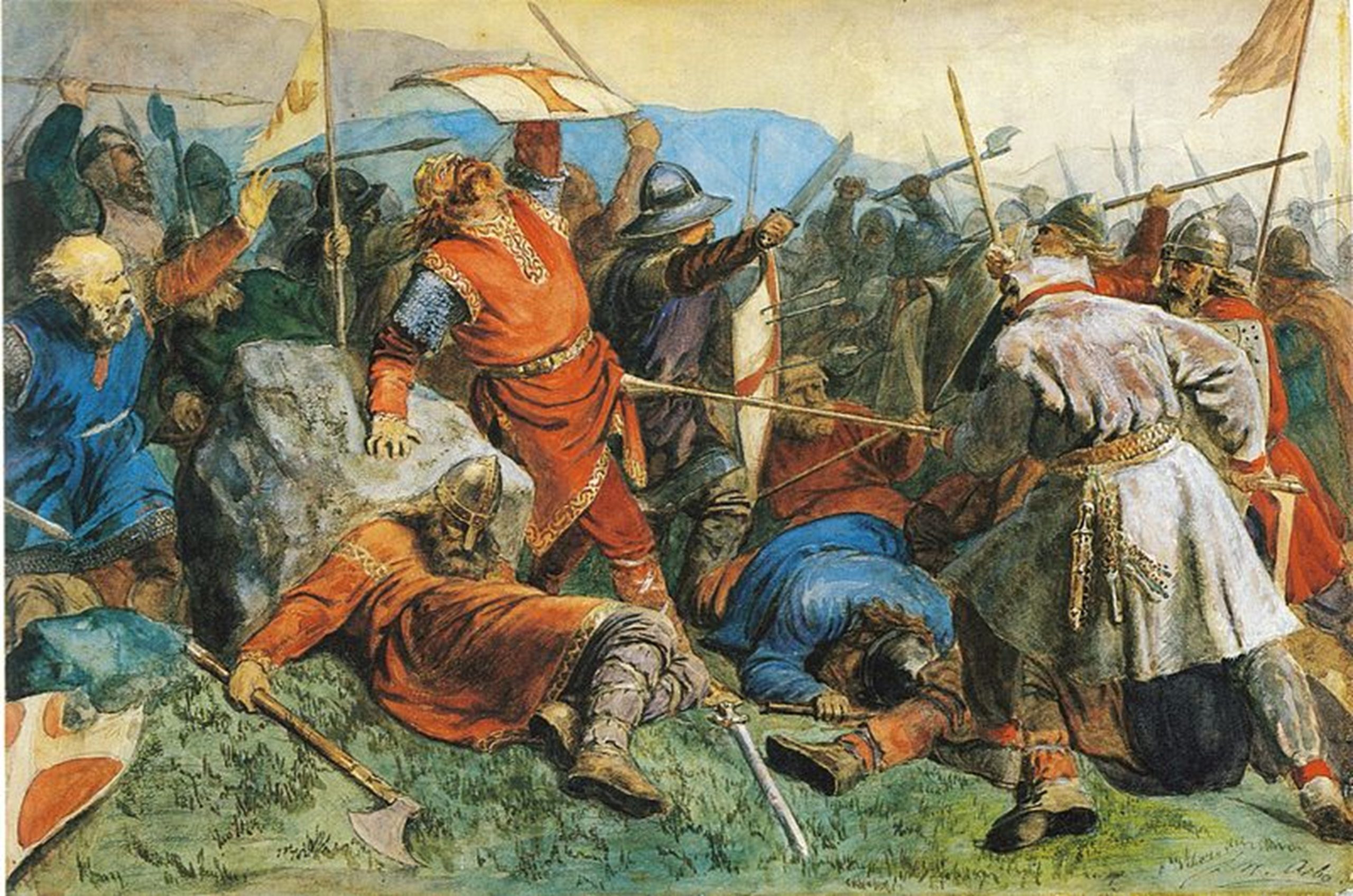
The political history of medieval Norway is mostly characterized by Viking raids and expansions, the struggle to unite the land under one ruler and the process of christianization, which joined Norway into the family of European kingdoms (Bagge 2014, 27). The Viking age is considered to have started in the late 8th century and had involved all of the Scandinavian lands from where Viking raids were conducted towards both Eastern and Western Europe. As a result, the Scandinavian peoples have through raids, conquests and colonization, spread not only fear and destruction, but also Nordic influence and culture across and beyond the European continent.
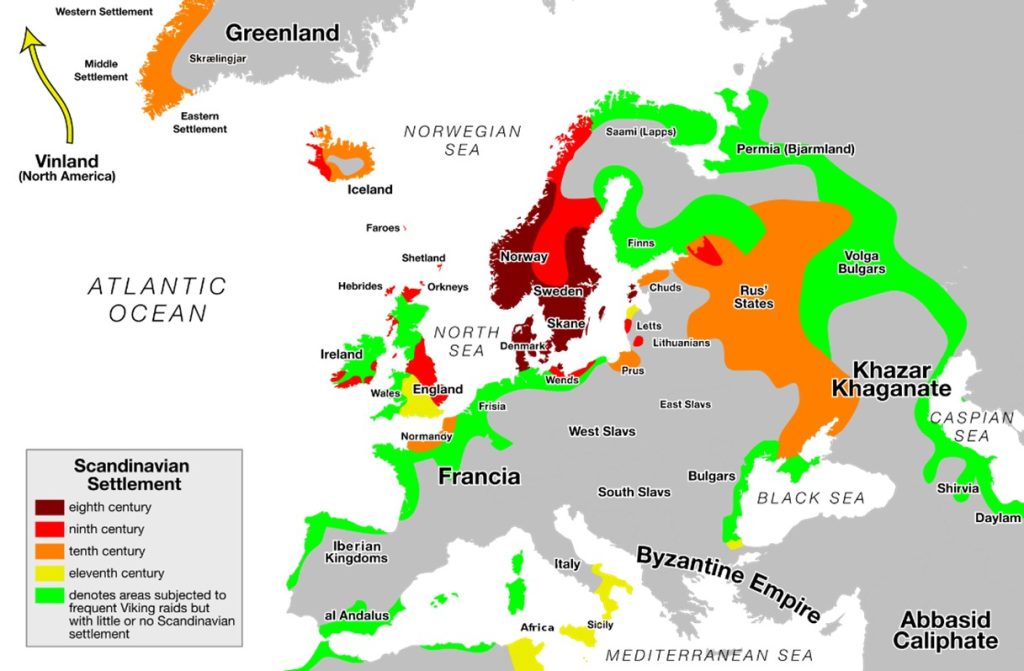
The attack on Lindisfarne, a monastery on the English coast in 793 is considered as the event which started the so called Viking age. The undefended and rich churches and monasteries of England, like Lindisfarne, were easy prey for the pagan warriors. However, priests and monks were not their only targets, they also managed to fight and defeat proper armies, raid across entire countries and take fortified cities, even sacking Paris in 845. However, the raids weren’t the only aspect of the Viking age, the Northmen settled previously uninhabited or scarcely populated lands and islands, establishing permanent settlements and their own rule.
The Norwegians sailed West during the 9th century and settled the islands of Orkney, Shetland and the Hebrides off the coast of modern Scotland, the Isle of Man between Britain and Ireland, the Faroe Islands, Iceland and Greenland which would all become part of the Kingdom of Norway. All of that was possible because of the distinctive Viking longship, which fully developed around the year 800 and could quickly sail the open seas, while its European counterparts were restricted to sailing close to the coastline (Bagge 2014, 25). Although it’s simple to understand how they managed to achieve that, there isn’t one answer as to why they did it. Many factors could be involved: the pressure of rising populations, the threat of famine, lack of land, political issues, and the warlike culture of the Nordic peoples in search for glory and riches (Roesdahl and Wilson 1992, 24-27. Bagge 2014, 28). The Viking age would end only with the emergence of strong feudal kingdoms in Europe, capable of organizing proper armies. One event that specifically marks the end is the battle of Stamford Bridge in 1066, where the Viking army under the Norwegian king Harald Hardrada was defeated by the English.
During this period, the kingdom struggled with the centralization of its power, the expulsion of Danish political influence and the process of christianization which caused turmoil in all of Scandinavia. The 9th and 10th centuries have been decisive for political consolidation of Norwegian lands. The land of modern Norway was split between a number of jarls, hersir or petty kings who were the political, military and religious leaders of their lands. In the late 8th century, the Danish king took control of the southern region of Viken where the local chiefs swore allegiance to the Danish monarch. That region will continue to be a basis for Danish claims and interventions in Norway until the 13th century (Helle 2008, 190). During the middle of the 9th century, some larger kingdoms were being formed; Northern Norway was unified by Hakon Grjotgardsson, the jarl of Lade and Halvdan the Black established a large kingdom in southeastern Norway. Harald Fairhair will inherit this kingdom, expand it north, and create an alliance with Hakon in order to subdue the rest of the country. Together, they conquered the west coast of Norway and brutally deposed any who opposed them. Last resistance was met at the battle of Hafrsfjord in 872 where the opposing chiefs, supported by the Danish, were defeated. Harald Fairhair married the daughter of the Danish king, took the region of Viken and became king of a unified Norway in 872. His conquest would not last as the kingdom was split among his descendants in 930 already, however his dynasty continued to rule western Norway for three generations with the last king being a Christian, Harald Greyhide, who died in 970 (Helle 2008, 191).
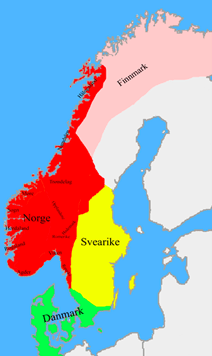
The unification of Norwegian lands into a single kingdom was not a sudden and quick process, and it is generally accepted that the real unification started around the beginning of the 11th century with the increased christianization of the people and elimination of last remnants of Danish rule in Norway (Helle 2008, 184). The Danish kingdom and Norway were closely linked and the decline of one, usually allowed for the prosperity of the other. The loss of power by Harald’s descendants in the second half of the 10th century saw the restoration of Danish monarchy under Gorm and Harald Bluetooth, the latter being ruler of Norway for a time as well. For a while, Bluetooth let Greyhide rule nominally, but later supported his rival Haakon Sigurdsson, the jarl of Lade, who eventually captured the kingdom and de facto ruled from 975-995. The rule over the Kingdom of Norway was then restored to the Fairhair dynasty with Olaf Tryggvason as king. Not much is known about his rule, but the sagas stress his missionary work. It was during his rule that strong attempts were made to christianize Norway and its western colonies, often done forcefully (Bagge 2005, 117). It is generally accepted that it was Olaf who built the first church in Norway in 995 and founded the city of Nidaros (Trondheim) in 997. He was often portrayed both as a Viking hero and a Christian king.
The three Nordic countries had all strongly influenced each other in forming the distinct three kingdoms of Sweden, Denmark and Norway. The naval battle of Svolder that took place around the year 1000 perfectly illustrates this. The battle was fought between the young Christian king of Norway, Olaf Tryggvasson and an alliance of Denmark, Sweden and jarl of Lade, near the later border where all three kingdoms meet (Bagge 2014, 28). Olaf managed to rout the Swedes and Danes, only to be defeated by his Norwegian adversary, Eirik Haakonsson. The battle resulted in the division of Norway which was now ruled by jarls Eirik and Svein Haakonsson serving as clients for the Danish king, Svein Forkbeard.

Their rule was prosperous and most sources say that they adopted Christianity, but allowed the people to follow the old faith, which lead to a backlash against Christianity and reversed much of Olaf’s missionary work. Their rule lasted until 1015 when Olaf Haraldsson returned to Norway from England, where he fought with the Danes against the English, but later found himself in the service of king Aethelred, converting to Christianity. The reasons of his return are not clear but it is thought that he came back as an opponent to the Danish king Knut, who was fighting to claim the English crown (Helle 2008, 193). Olaf met no opposition from jarl Eirik or his son Hakon, but Svein raised an army to fight him. The forces met in a naval battle at Nesjar (Brunlanes) at the southern edge of Vestfold on 1016 where Svein was defeated and fled. After the battle, Olaf consolidated the kingdom and gained support of the magnates, his kingdom now stretched across most of modern Norway. He had brought priests and bishops from England and continued Tryggvason’s missionary work – for the first time elements of church organization and church laws were implemented. Christianity was established among a larger part of the population.
Tensions in the kingdom arose in the 1020s when king Knut demanded supremacy over Norway so Olaf forged an alliance with the Swedish king Anund Jakob to counter the Danish king who also ruled England at the time. The two kings attacked Denmark in 1025/26 and faced Knut’s large fleet coming from England, at the battle of Helgea in Skane. It’s not sure which side was victorious in the battle, but Knut managed to find allies on the Norwegian coast and had begun to sow dissent against Olaf. Knut was successful, the magnates turned against Olaf when his strong supporter Erling Skjalgsson died in battle in 1027. Knut arrived in Norway with a strong fleet in 1028 which forced Olaf to seek refuge with Prince Yaroslav of Kiev-Novgorod, his brother-in-law. Knut became king of Norway and reinstalled Hakon Eriksson, as his Jarl of Norway. However, Hakon was lost at sea in 1029, an opportunity which Olaf decided to take and started his journey from Russia to take back the kingdom. Again, he was assisted by the Swedish king and given a strong force to accompany him, joined also by Harald Sigurdsson – the future King Harald Hardrada and his men. It was not enough, an even stronger force opposed them when they entered Trondelag in July 1030, killing Olaf and defeating his forces in the battle of Stikelstad (Helle 2008, 194).
Knut was victorious, but five years later, his rule in Norway was already breaking down. Because Knut decided not to rule Norway through a client Norwegian ruler, but imposed his own son Svein to be king. Knut started creating laws and building up a regime based on English patterns – expanding the power of the king and the financial basis of the kingdom, which in turn pushed his former Norwegian allies aside. They made an alliance with Grimkell, the bishop of Nidaros and an old ally of Olaf. In 1034 the leaders of the previous coalition against Olaf went to Russia to bring his son Magnus to Norway and crown him as their king in the following year (Helle 2008, 195). His father was canonised as a saint by the bishop of Nidaros right after he fell during the battle of Stikelstad which had a substantial impact on the Norwegian kingdom, allowing both Magnus and later Harald Hardrada to ascend the throne due to their family connections, the former being his son and the latter, his half-brother.
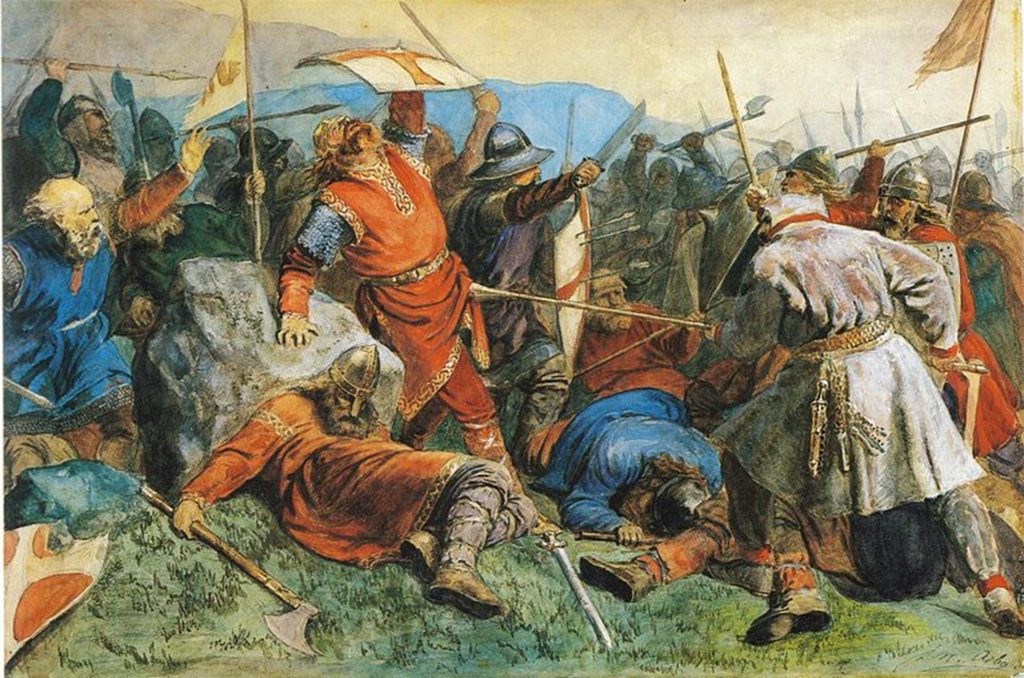
In 1040, Magnus attempted to take the Danish throne from Knut’s son Harthacnut, but the nobles of both kingdoms persuaded the kings to agree that if one of them dies, the other will succeed him. Harthacnut died in England in 1042 and Magnus became king of Denmark as well as Norway (Bagge 2014, 32). Magnus’ rule will be contested in 1046 by the future Harald Hardrada after his return from Russia. He created an alliance with the Swedish king Anund Jacob and started harassing Magnus’ Danish coastal towns to turn the people against him. However, there would be no battle between Harald and Magnus; the two relatives reached an agreement in 1047 to share rule over Norway in turn for half of Harald’s badly needed wealth. Their co-rule ended in less than a year since Magnus died, leaving Norway to Harald and Denmark to Svein Estridsson. Harald planned on forcefully taking Denmark from him, but his army chieftains opposed him and refused a full scale invasion. However, Harald would harass Denmark and Svein with swift violent raids continually from 1049 to 1064 almost every year. Despite many Harald’s military victories over Svein, exhaustion forced them both to a peace agreement in 1064, recognizing each others’ kingdoms with former borders and no necessary reparations (Bagge 2014, 32).
Harald moved towards centralizing the kingdom by allowing only the king to retain a hird (a professional armed retinue and council). Harald would continue with domestic struggles to secure his rule and supremacy which would earn him the nickname Hardrada or Hard-ruler. Harald attempted to claim the English crown ever since he ascended as king of Norway but had to resolve the conflict with Svein first. Harald landed in England in 1066 with an army of seven to nine thousand men enforced by forces from Orkney, Scotland and even Flanders, defeating a Mercian army and taking York. However, the Norwegians were surprised by Harold Godwinson’s English army and defeated at Stamford Bridge the same year. Norwegian casualties were supposedly so high that out of 300 ships that brought the men and supplies to England, only 24 were needed for their return (Giles and Ingram 1992). The battle decisively ended the legendary Viking age.
During the 11th and 12th centuries, the Kingdom of Norway will start to resemble European kingdoms ever more closely. Its consolidation was based on royal and ecclesiastical cooperation, the nobility started creating stronger connections with north European princes through diplomacy, negotiations, political agreements and intermarriage (Helle 2008, 197). Even though all rulers of Norway after Harald Fairhair were Christian (except Eirik Bloodaxe), the christianization of Norway was a gradual process. The close connection between Norway and Christian Europe, especially England, through Viking raids and trading expeditions was an important factor. Most kings were baptized abroad and returned as Christians as most missionaries and bishops in Norway were English (Bagge 2005, 114-115. Helle 2008, 194). As the king was head of the Norwegian church in the 11th and 12th centuries, he was crucial in securing the end result and the establishment of an organized church and prohibition of the old pagan faith (Bagge 2014, 38. Bagge 2005, 116, 119-121. Helle 2008, 196-198). Christianity and the Church served as an instrument in the monopolization of power and the further development and continuation of the kingdom and dynasty. From the middle of the 11th century, Scandinavia consists of three kingdoms: Sweden, Norway and Denmark, and the approximate borders that were established remained basically the same until the middle of the 17th century (Bagge 2014, 38).
Bibliography:
Bagge, Sverre. 2005. „Christianization and state formation in early medieval Norway“, Scandinavian Journal of History, Vol. 30, No. 2 (June), 107-134.
Bagge, Sverre. 2014. Cross and Scepter: The Rise of the Scandinavian Kingdoms from the Vikings to the Reformation. Woodstock: Princeton University Press.
Helle, Knut, ed. 2008. The Cambridge History of Scandinavia Volume I: Prehistory to 1520, Cambridge: Cambridge University Press.
Roesdahl, Else and Wilson, David M., eds. 1992. From Viking to Crusader: The Scandinavians and Europe 800-1200. New York: Rizzoli International Publications.
Sources:
The Anglo-Saxon Chronicle. 1996.Translated by Giles, John Allen and Ingram, James. Project Guthenberg. http://www.gutenberg.org/cache/epub/657/pg657.html
Arbo, Peter Nicolai. 1860. „Battle at Svolder“, Arild Hauge – Historical Paintings. Last modified October 31, 2005. http://www.arild-hauge.com/paintings.htm
Arbo, Peter Nicolai. 1859. „Battle of Stikelstad“, Wikimedia Commons. Last modified November 6, 2005. https://commons.wikimedia.org/wiki/File:Arbo-Olav_den_helliges_fall_i_slaget_p%C3%A5_Stiklestad.jpg
Naylor, Max. 2007.„Viking Expansion“, Wikimedia Commons. Last modified February 25, 2018. https://commons.wikimedia.org/wiki/File:Viking_Expansion.svg
Tokle, 2005. „Norway 1020 AD“, Wikimedia Commons. Last modified August 12, 2017.https://commons.wikimedia.org/wiki/File:Norway_1020_AD.png
Autor:
Recenzenti:
- Dominik Pešut, voditelj projekta, voditelj recenzijskog tima;
- Lucian Borić, član recenzijskog tima;
- Mihaela Marić, članica recenzijskog tima;
- Ivan Grkeš, član recenzijskog tima.
Ovaj esej objavljen je u Anno Domini Enciklopediji, dijelu međunarodnog projekta Anno Domini, na gromovnik.hr – mrežnoj stranici Udruge “Gromovnik”.